Substack
Essays and research notes
Longer-form writing from Hayashi — research notes, working arguments, and commentary on digital markets, mechanism design, and AI-native economics.
Insights
Until the on-site archive launches, Hayashi’s writing lives on Substack and X.
Substack
Longer-form writing from Hayashi — research notes, working arguments, and commentary on digital markets, mechanism design, and AI-native economics.
X · Twitter
Shorter commentary, threads, and highlighted discussions around ongoing projects and the broader research conversation.
Background reading
Economics and computation, usually shortened to EconCS, is the field that forms where market design, game theory, and algorithm design stop being separable problems.
Cornell University · College of Arts and Sciences
Search ad auctions, matching markets that place students and organs, pricing and recommendation systems that participants learn to game: each is at once an economic question about how people respond to incentives and a computational question about what can be solved at the scale the market actually runs on. EconCS is what results when both questions are answered together rather than in sequence.
Cornell is where much of that conversation began, and this article is the clearest short account of how it happened. It follows the field from informal exchanges between economists and computer scientists in the late 1990s, through the 2005 “Getting Connected” initiative, to the Networks course David Easley and Jon Kleinberg built and the textbook that grew out of it. Readers new to this work should read it first: it conveys what the field is and why it exists in plain language, before any technical paper asks for a formal model.
Reading list
Eight books, recommended because they were worked through and not because they are the ones people name. The usual advice for entering this field sends a newcomer to Mas-Colell, Whinston and Green for the theory and to Rudin for the mathematics. Neither is a good way in.
Two notes before the list. It is a personal recommendation from T.Y. Hayashi, collected with the people he works alongside, and it is neither a survey of the field nor a syllabus anyone has endorsed. It also ranks books on one axis only, which is how well each one works as a way into economics and computation. That axis is what makes the standard graduate texts look poor here. Mas-Colell, Whinston and Green and Rudin are superb at what they set out to do; what they set out to do is not this. A reader headed for EconCS gets several hundred pages of general equilibrium and measure theory before meeting anything a paper in this field will ask them to use, and arrives still missing the computational vocabulary those papers assume. None of that is a verdict on how good a book is.
Where the incentive problem gets posed, and what has to hold for a mechanism to do what it claims.
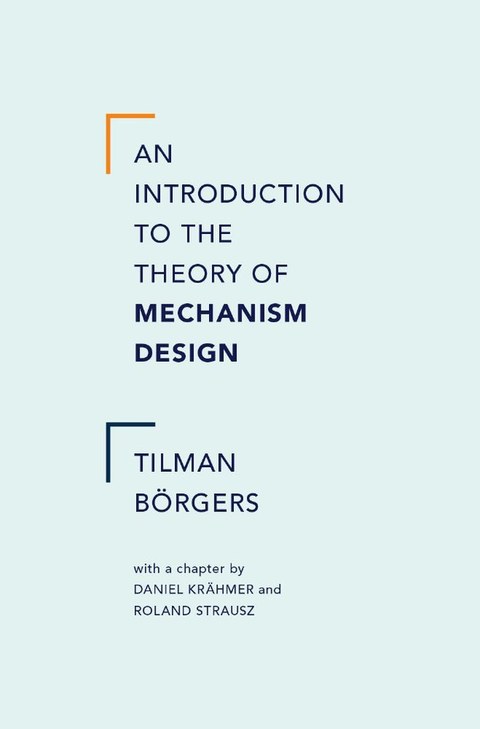
Oxford University Press, 2015
The cleanest statement of the problem in the economist's idiom: types, incentive compatibility, the revelation principle, Myerson's revenue characterisation, each derived slowly and with no machinery you have not been handed.
For EconCS readersTwo books here cover this ground in forms that suit an EconCS reader better. Hartline's Mechanism Design and Approximation states it the way papers in the field actually state it, and Vohra's linear programming treatment recasts the same classical results in the language both halves of the field share. Readers heading that way get further starting from those two and keeping this one open beside them.
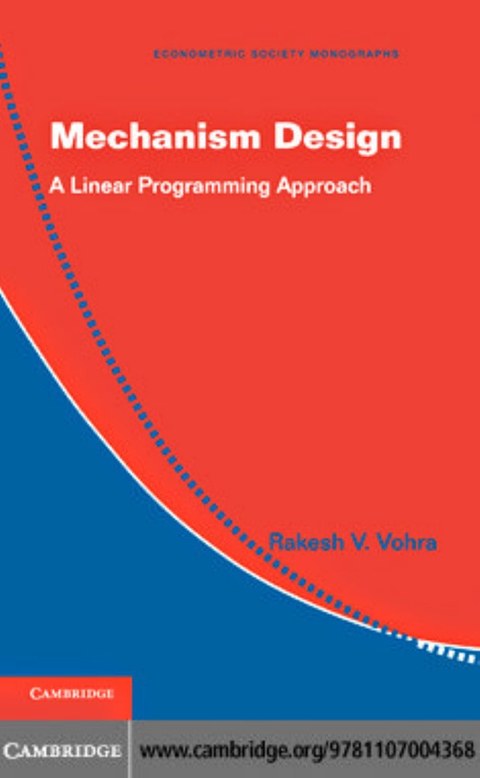
Cambridge University Press, Econometric Society Monographs, 2011
Incentive compatibility written as a linear program, with the classical results falling out of duality and shortest paths. This is the shortest bridge between the two halves of the field: an economist finishes it able to read the algorithms literature, and a computer scientist finishes it able to read the theory. The duality it runs on is set up in Vohra's Advanced Mathematical Economics, which is the book to clear first.
Or start hereAhead of Börgers for anyone headed into EconCS. The same classical results arrive in the language the algorithms side already speaks.
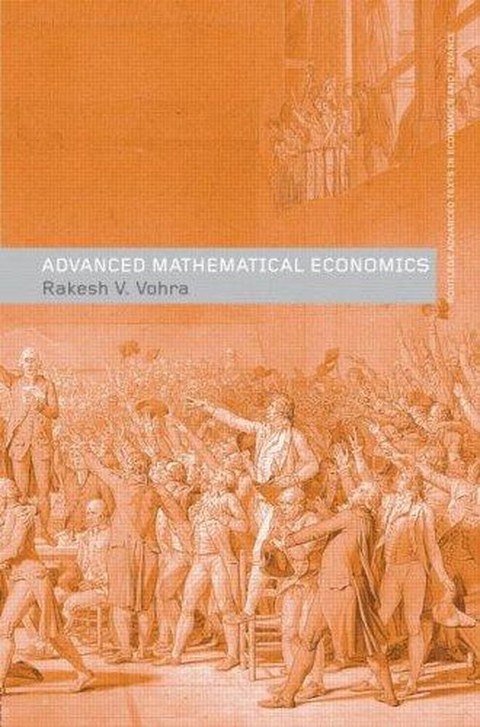
Routledge, Advanced Texts in Economics and Finance, 2005
Two hundred pages covering the mathematics these models lean on, in the order the models reach for it: linear programming and duality, fixed points, convexity, lattices and monotone comparative statics. It assumes you want the tools in order to use them today.
Read this firstThe prerequisite for Vohra's own Mechanism Design: A Linear Programming Approach. Duality and the linear programming machinery carry that book from the first page, and this is where they get set up.
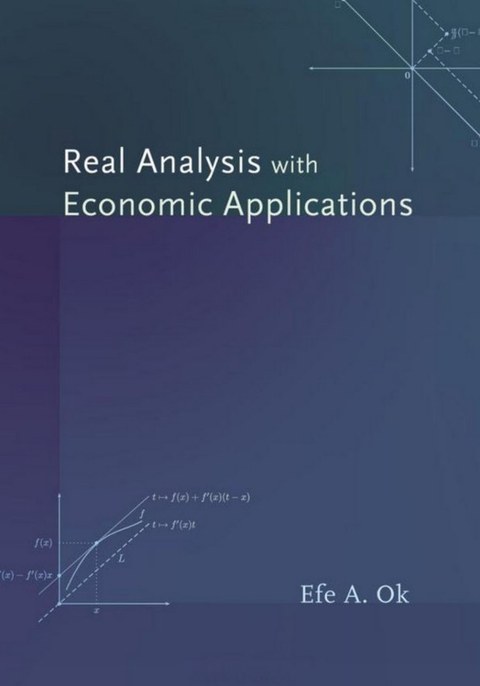
Princeton University Press, 2007
A better fit for an economics student than the standard real analysis texts. Rudin's Principles of Mathematical Analysis, baby Rudin to everyone who has been assigned it, is written for mathematicians and motivates each result from inside mathematics. Here every abstraction arrives attached to the economic question that produced it, so metrics, compactness and fixed points earn their keep on first contact, and the book doubles as the reference to reach for once a proof needs one.
Where the same problem is treated as something that has to be computed, approximated, and survive contact with scale.
Manuscript, Northwestern University, revised through 2017
The organising text of the field, and the one to start from. It opens where the classical theory closes: optimal mechanisms stop existing once the environment gets even slightly realistic, so the live question becomes how much a simple mechanism gives up and how you prove that bound. Free from the author's page.
Start hereBetter suited to an EconCS reader than Börgers, and the two overlap enough that this can carry the first pass.
Cambridge University Press, 2007
The reference volume, best used as a map rather than read front to back. Equilibrium computation, price of anarchy, algorithmic mechanism design and network games, each surveyed by the people who opened the area.
Cambridge University Press, 2016
Twenty self-contained lectures from the Stanford course, each one problem and its resolution. The fastest route we know from no background at all to reading current papers, and the right first purchase if you buy only one book on this page.
Cambridge University Press, 2011
Not a book about markets, and still the one that supplies the technique the rest of this list runs on: relax, round, and bound what you built against an optimum nobody can compute. Approximation guarantees in mechanism design are this argument with incentives bolted on. Free from the authors' site.
Cover images are the publishers' own jackets. The Hartline manuscript has never been printed and so has none; that plate is ours.
Working notes
Automated tools for mathematics are usually sorted by what they compute. Sorting them by who the reader has to trust instead reorganizes the landscape into four roles, and separates the results that are cheap to obtain from the results that are cheap to defend.
| Role | Asks | Returns | Who must be trusted |
|---|---|---|---|
| Falsifier | Is there a counterexample? | a witness | nobody |
| Certifier | Can it become an identity? | a certificate | nobody |
| Bounder | How large can it be? | a proved enclosure | the interval library |
| Decider | True or false? | a verdict | that solver |
Working note · August 20, 2026
A witness and a certificate can be rechecked by anyone with a computer algebra system. A verdict cannot: unsatisfiable is the solver asserting that it searched exhaustively. So every use of a decider enlarges the trusted base and hands a referee one more thing to question, while the first two roles enlarge it by nothing at all.